

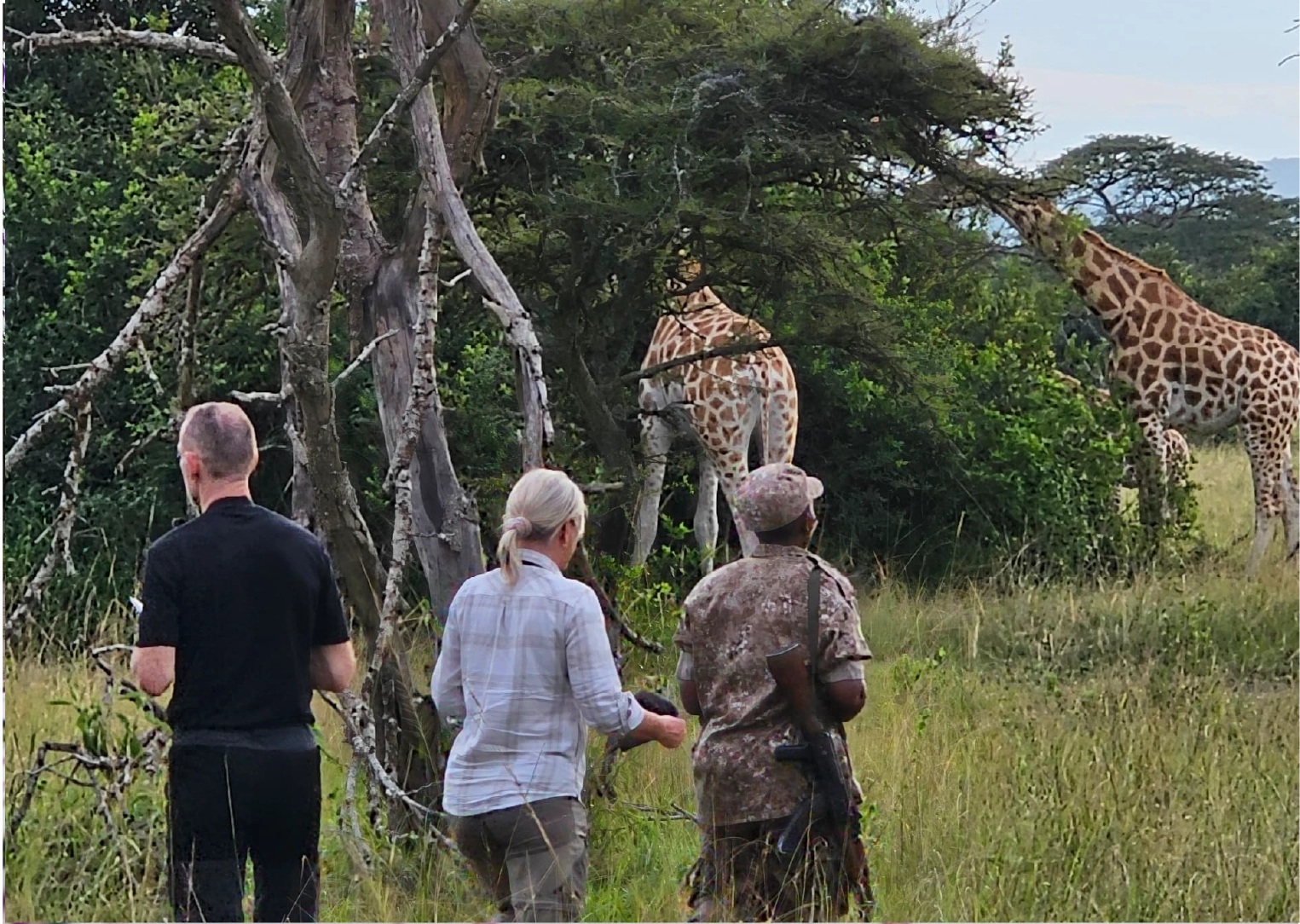
The first thing you notice isn’t what you see—it’s what you hear. A distant rustle in the grass. The soft crunch of your boots on dry earth. The steady breath you didn’t realize you were holding. Standing at the edge of the wilderness in Lake Mburo National Park, I quickly understood that this was nothing like the safaris I had imagined. There was no vehicle, no barrier—just me, a guide, and the wild.
Leaving the Comfort Zone Behind
Most safaris in Uganda happen from the safety of a 4×4, where you observe wildlife from a distance. But a walking safari in Uganda flips that experience completely.
Here, you step into the animals’ world.
Before we set off, our armed ranger briefed us calmly. The rules were simple but serious—stay close, stay quiet, and always follow instructions. It wasn’t about fear; it was about respect. And with that, we walked.
Every Step Feels Alive
The bush feels different when you’re on foot. You notice things you would never see from a vehicle—fresh hoof prints, broken branches, the subtle movement of birds signalling something nearby. Our guide stopped suddenly and pointed to the ground. Tracks. Not old ones—fresh.
In that moment, your senses sharpen. Your heartbeat picks up. You’re no longer just a visitor; you’re part of the environment. This is what makes guided safaris in Uganda so unique—they awaken something primal, something real.
Eye-Level Encounters
It didn’t take long before we spotted our first animals.
A group of zebras grazed quietly in the distance, their stripes glowing under the morning sun. Unlike a game drive, where animals often move away quickly, here they seemed more curious than threatened. We moved slowly, keeping a respectful distance. Then came the giraffes.
Tall, graceful, and almost surreal, they watched us with calm curiosity. Seeing them at eye level—without the frame of a vehicle window—felt deeply personal. There was no glass, no engine noise—just a silent understanding that we were guests in their space.
Moments like this define a walking safari experience.
The Thrill of the Unknown
As we ventured deeper, the landscape opened up into wide savannah. The guide raised his hand—another stop.
Buffalo.
A small herd, not too far ahead.
This was different. The atmosphere shifted instantly. Buffalo are powerful and unpredictable, and this was where the importance of our guide became clear.
We changed direction slowly, carefully, without panic.
There’s a unique kind of thrill in knowing you are vulnerable—but safe because you trust the expertise of those leading you. It’s not about danger; it’s about awareness.
More Than Just Big Animals
What surprised me most was how much I began to appreciate the smaller details.
Dung patterns that tell stories of diet and movement. Insects working tirelessly beneath the surface. Plants with medicinal uses passed down through generations.
A walking safari isn’t just about spotting animals—it’s about understanding the ecosystem.
In places like Lake Mburo National Park, every element has a role, and every step reveals something new.
A Deeper Connection to Nature
There’s something profoundly humbling about being on foot in the wild.
You’re no longer just observing—you’re participating. You feel the heat of the sun, the texture of the land, the unpredictability of nature.
It slows you down.
It teaches patience.
And most importantly, it creates a connection that no vehicle safari can replicate.
For travellers seeking unique safari experiences in Uganda, this is as authentic as it gets.
Is It Safe?
This is one of the most common questions—and rightly so.
The answer is yes, when done correctly.
Walking safaris in Uganda are always guided by trained professionals and armed rangers. They understand animal behavior, terrain, and how to respond in different situations.
Safety isn’t left to chance—it’s built into every step of the experience.
Why You Should Try It
Uganda is famous for its incredible wildlife—from gorilla trekking in Bwindi Impenetrable National Park to game drives in Murchison Falls National Park. But walking safaris offer something different.
They offer intimacy.
They offer perspective.
They remind you that nature isn’t something to watch—it’s something to feel.
Planning Your Walking Safari in Uganda
If you’re considering this experience, here are a few tips:
- Choose destinations known for walking safaris like Lake Mburo National Park
- Wear neutral colors and comfortable walking shoes
- Follow your guide’s instructions at all times
- Bring a camera—but don’t forget to be present
Most walking safaris are done in the early morning or late afternoon, when wildlife is most active and the temperatures are cooler.
A Memory That Stays With You
As we made our way back, the sun had risen higher, and the bush was fully awake.
The sounds felt familiar now. The fear had turned into excitement. The unknown had become something to appreciate, not avoid.
And that’s the magic of a walking safari.
It changes the way you see wildlife—and the way you see yourself within it.
If you’re looking for an experience that goes beyond the ordinary safari, one that immerses you fully in the wild, then walking with wildlife in Uganda might just be the adventure you didn’t know you needed.